Peak Design Leash: A Lightweight Camera Strap
I am particular about camera straps. Okay, I am particular about quite a few things, but we are only talking about camera straps today.
I used the same style for almost ten years, beginning with my first camera. It was a soft neoprene strap from Tamrac, and it felt just right with a DSLR. When Tamrac stopped making it, Kim graciously gave me hers, which she had purchased shortly before the straps were discontinued.
That left Kim without a camera strap, so she began shopping and chose the Peak Design Slide. It could be worn around the neck, over the shoulder, or across the body as a sling.
We also had a couple of retro woven straps that looked perfect on our older film SLRs. Those cameras were smaller and lighter, and the colorful vintage straps suited them.
I was still satisfied with my Tamrac strap, although I felt a little jealous whenever Kim carried her camera comfortably at her side with the Slide. Then I bought a small Fuji mirrorless camera.
Finding a Strap for the Fujifilm X100T
I found a great deal on a used Fujifilm X100T from KEH Camera, and my beautiful new-to-me camera needed a strap.
The thick Tamrac strap felt like overkill on such a compact camera. Our vintage straps looked great, but their metal attachments rested against the silver finish, and I did not want them rubbing or scratching it.
When I discovered that Peak Design made a smaller strap designed for compact and mirrorless cameras, the Leash immediately looked like the right match.
Adjusting and Wearing the Leash
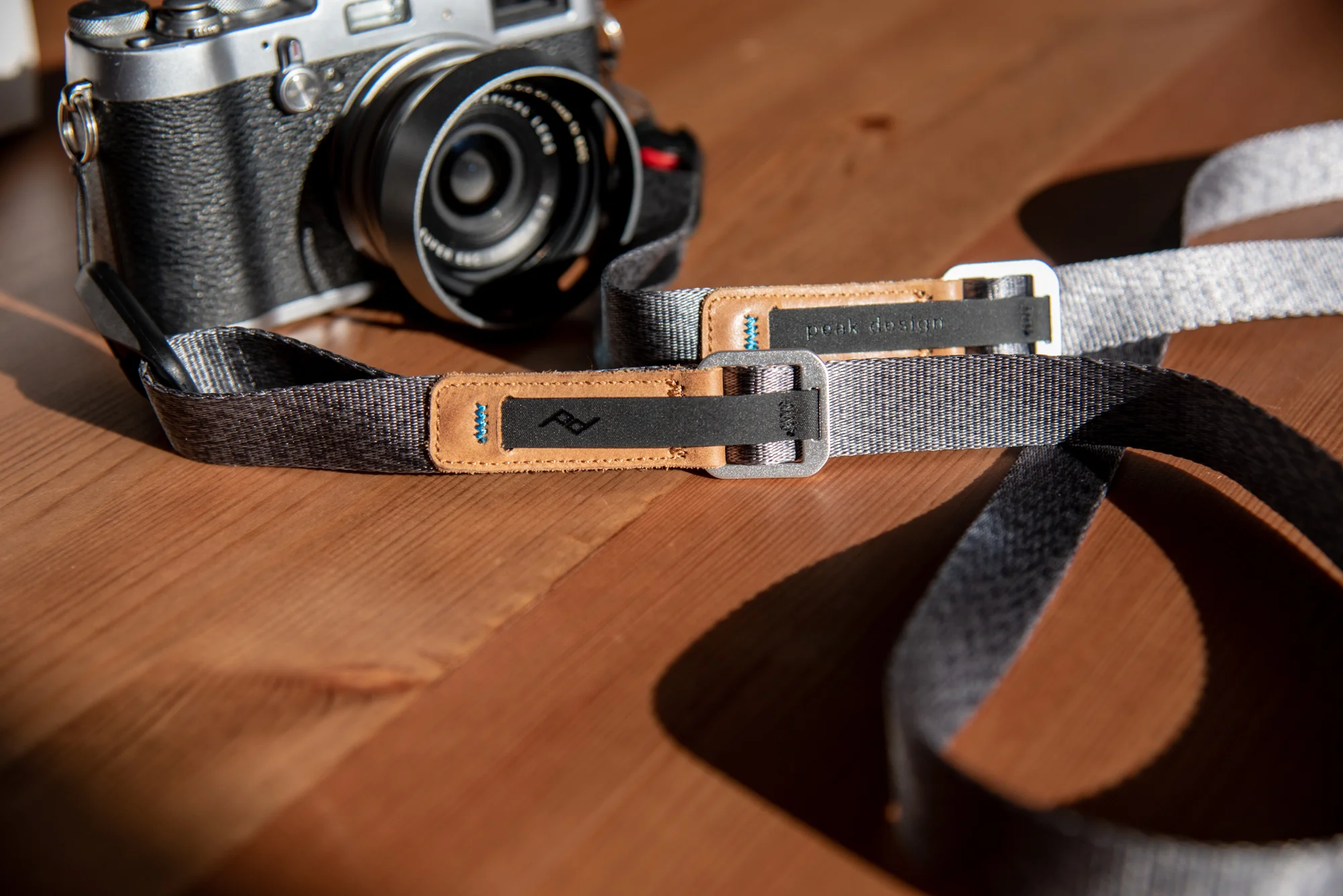
The Leash was made from smooth webbing that reminded me of a very soft seat belt. It felt light and flexible while still giving me confidence that it could support the camera securely.
Its length could be adjusted for several carrying positions. I could shorten it into a traditional neck strap, lengthen it for my shoulder, or wear the camera across my body as a sling.
The quick-adjustment system became my favorite feature. Aluminum and Hypalon adjusters on both sides allowed me to change the length with one finger. I could pull the camera close to my body while walking, then loosen the strap and raise it when I wanted to make a photograph.
That simple movement worked so smoothly that I found myself using it constantly.
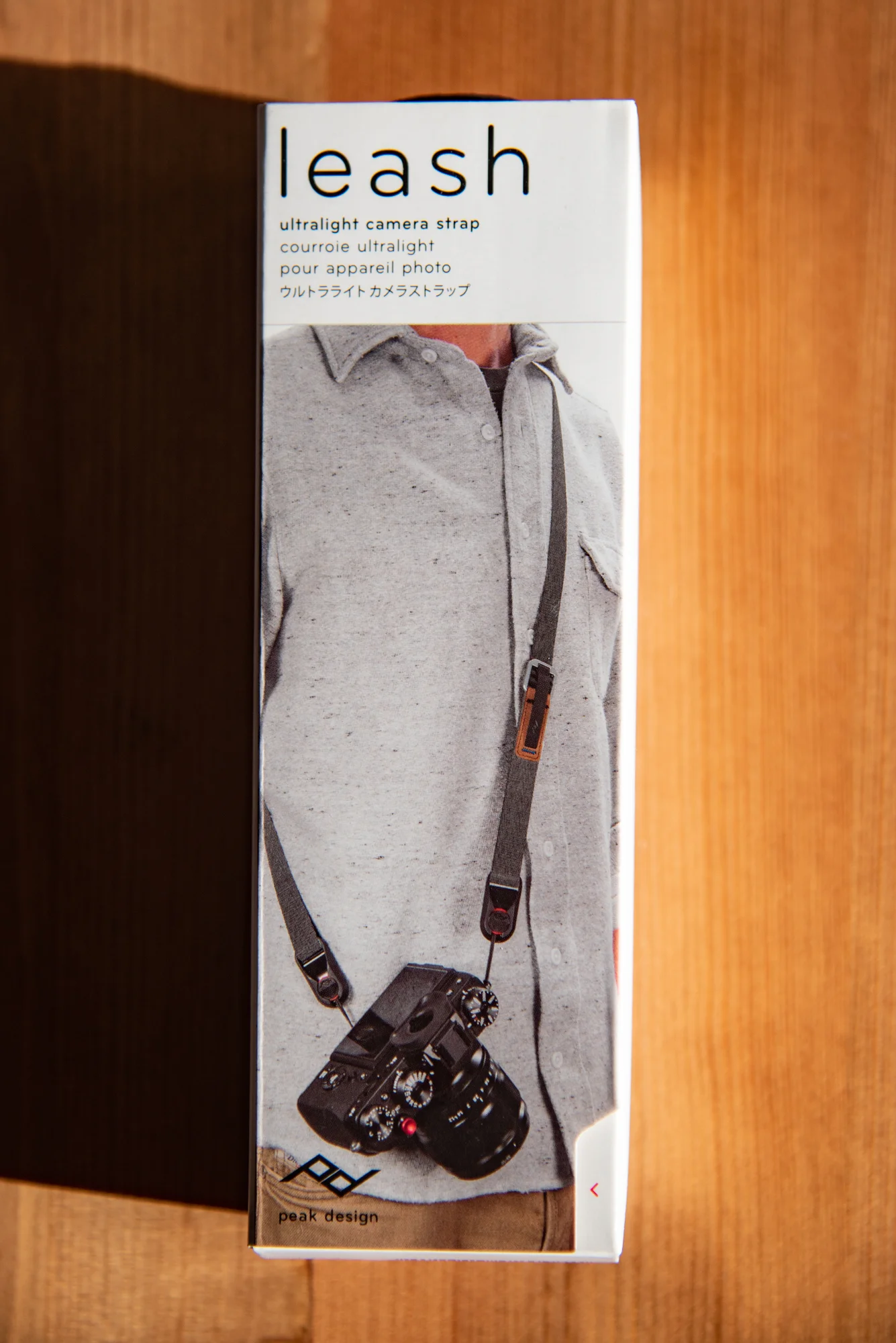


The webbing glided easily across my clothes when I wore the camera as a sling. It did not have a rubberized section intended to grip my shoulder, which could be a benefit or a drawback depending on how someone carried a camera.
For me, the smooth surface was exactly what I wanted. I rarely wore the Leash over only one shoulder. Most of the time, I used it as either a cross-body sling or a neck strap, so I wanted it to move freely.
Peak Design’s Anchor Link System
The Leash came with Peak Design’s improved Anchor Links. They still worked with the company’s older anchors, but the included version had a thinner cord and a smaller, reshaped connector.
Each Anchor attached to one of the camera’s strap lugs, then clicked securely into the connector on the Leash. Pressing the round Anchor allowed it to slide back out, making the strap easy to remove or move between cameras.
The cord also contained a visible wear indicator. If the outer layer began to fray, a red inner layer would appear, signaling that it was time to replace the Anchor.
Despite their small size, the Anchors were rated to hold more than 200 pounds. That was far more weight than any camera I planned to attach, but it made the little connectors feel much more reassuring.


Sharing Straps Between Cameras
The Anchor Link system made the Leash useful beyond the X100T. The strap came with four Anchors, which gave me enough to prepare two cameras.
Once the Anchors were installed, I could disconnect the Leash from one camera and attach it to another in seconds. I did not need to thread a strap through the camera lugs every time or keep a separate strap permanently attached to every camera I owned.
That interchangeability also made me consider buying the wider Peak Design Slide for my DSLR and heavier film cameras. I could use the Leash when I wanted a minimal strap on the Fuji, then move to the padded Slide when carrying a larger body and lens.
After years of using one familiar Tamrac strap, I had finally found a replacement system that suited several cameras instead of only one. The Leash felt soft and comfortable, adjusted easily while I was wearing it, and looked as though it belonged on my little Fuji.
A Comfortable Match for a Small Camera
The Leash was an excellent match for my Fuji in both appearance and function. The quality of the materials and construction was obvious as soon as I opened the package, but the comfort became clearer once I began carrying the camera.
The narrow strap did not overwhelm the compact X100T, and the soft webbing never felt stiff against my neck. It also folded down small enough to tuck easily into a camera bag.
The Ash color was what first caught my attention. Its soft gray webbing looked distinctive without being loud, and I loved the subtle blue details. It also complemented the silver-and-black finish of the Fuji beautifully. Yes, I was choosing a practical piece of camera equipment, but I still wanted it to look good on the camera.