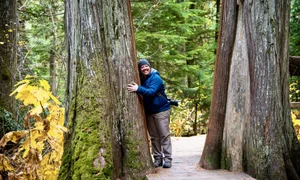

North Cascades National Park is one of the quieter national parks in the country, partly because of its remote location and rugged landscape. Much of the park is wilderness, but the North Cascades Highway makes some of its scenery surprisingly accessible. Along the road, overlooks and short trails open onto steep forested valleys, waterfalls, sharp mountain peaks, and water so vividly turquoise that it hardly looks real.
We chose the scenic drive recommended at the North Cascades Visitor Center near Newhalem. The rangers also gave us a list of day hikes, including several shorter trails that fit easily into a drive through the park. After talking with a ranger and getting our national park passport stamp, we headed east along Highway 20 to see what the North Cascades would share with us.
Kim was especially hopeful that we might see mountain goats somewhere among the rocky slopes, but they stayed well out of sight that day.
Gorge Creek Falls
Our first stop was Gorge Creek Falls, where a short trail leads from the parking area to views of the waterfall, gorge, and surrounding mountains. It was quite warm, and the exposed overlook felt even hotter in the afternoon sun.
The waterfall was pretty, but what caught my attention was our first glimpse of that strangely bright turquoise water. Even from a distance, the color stood out against the dark green forest. The trail was a short walk from the parking area and gave us our first real sense of how steep and layered this landscape is.


Diablo Dam


From the highway, we followed the narrow road toward Diablo and crossed the dam to a tiny parking area with only a few spaces. We walked back onto the dam while the wind whipped around us, strong enough to make the exposed crossing feel even more dramatic.
On one side was the enormous turquoise reservoir. On the other, the concrete face of the dam dropped sharply toward creeks, waterfalls, and dense forest below. Diablo Dam rises 389 feet and was the tallest dam in the world when it was completed in 1930. Standing on top of it, with the water on one side and that immense drop on the other, made its scale difficult to take in.
Diablo Lake Overlook


Diablo Lake Overlook was one of the busier stops along the highway, although nothing we visited that day felt truly crowded. The larger parking area opened onto a wide view of the lake, with mountains rising around it in every direction.
Far below us, a single kayaker moved across the turquoise water. The little boat was barely more than a speck, but it gave the lake a sense of scale that was otherwise hard to grasp.
The lake’s color comes from fine sediment known as glacial flour. Glaciers grind rock into a powder that is carried into the reservoir by streams and rivers. Those suspended particles scatter the light, creating the milky turquoise color that makes Diablo Lake look almost illuminated from within.
Diablo Lake is a reservoir held behind Diablo Dam and is part of the Skagit River Hydroelectric Project, which generates electricity for Seattle. Knowing the lake was shaped by both glacial processes and human engineering added another layer to the view, but it was still the color that held our attention.
Looking beyond the water, we could see lingering snow and ice tucked into portions of the surrounding mountains. More than 300 glaciers remain across the North Cascades, although exactly what is visible from the overlook depends on the season, weather, and snowpack.
Rainy Lake


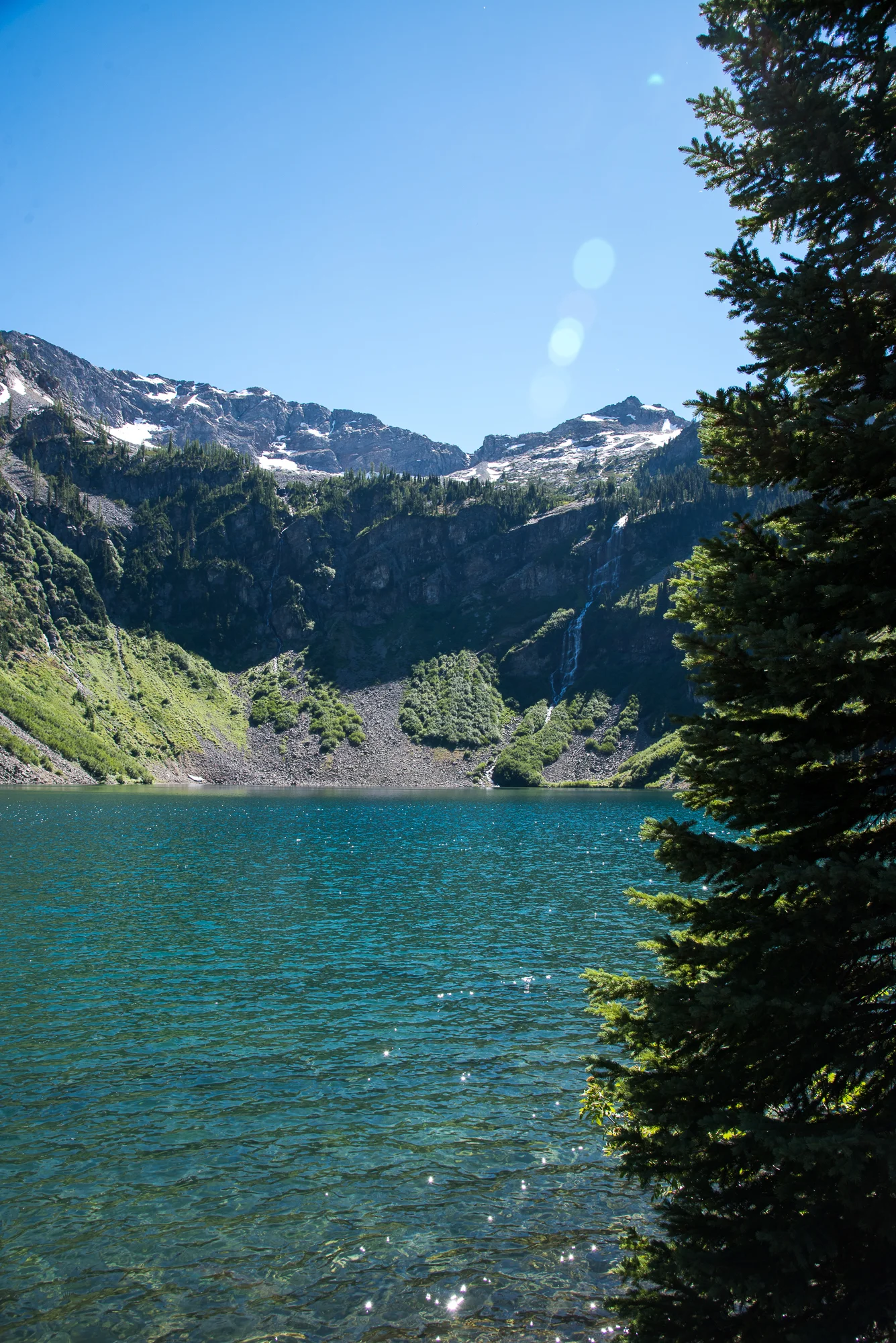
We continued east on Highway 20 for another 24 miles until we reached the Rainy Pass trailhead in Okanogan-Wenatchee National Forest. Several longer and more demanding trails begin here, including the popular Maple Pass Loop, but it was already afternoon and we wanted something shorter.
Rainy Lake Trail was a perfect choice. The paved trail runs for about one mile through dense forest before reaching the lake, making the hike roughly two miles round trip with very little elevation change.
The forest felt cool and enclosed after the open highway overlooks. Water moved down the surrounding slopes, and a waterfall spilled from the mountains at the far end of the lake. Patches of snow still clung to shaded areas along the mountains and even lingered in a few places beneath the trees.
It was warm enough that the damp forest was full of tiny flying insects. Rainy Lake did not have the startling turquoise color or enormous scale of Diablo Lake, but it felt quieter and more intimate, tucked beneath the mountains at the end of the forest trail.
Washington Pass Overlook
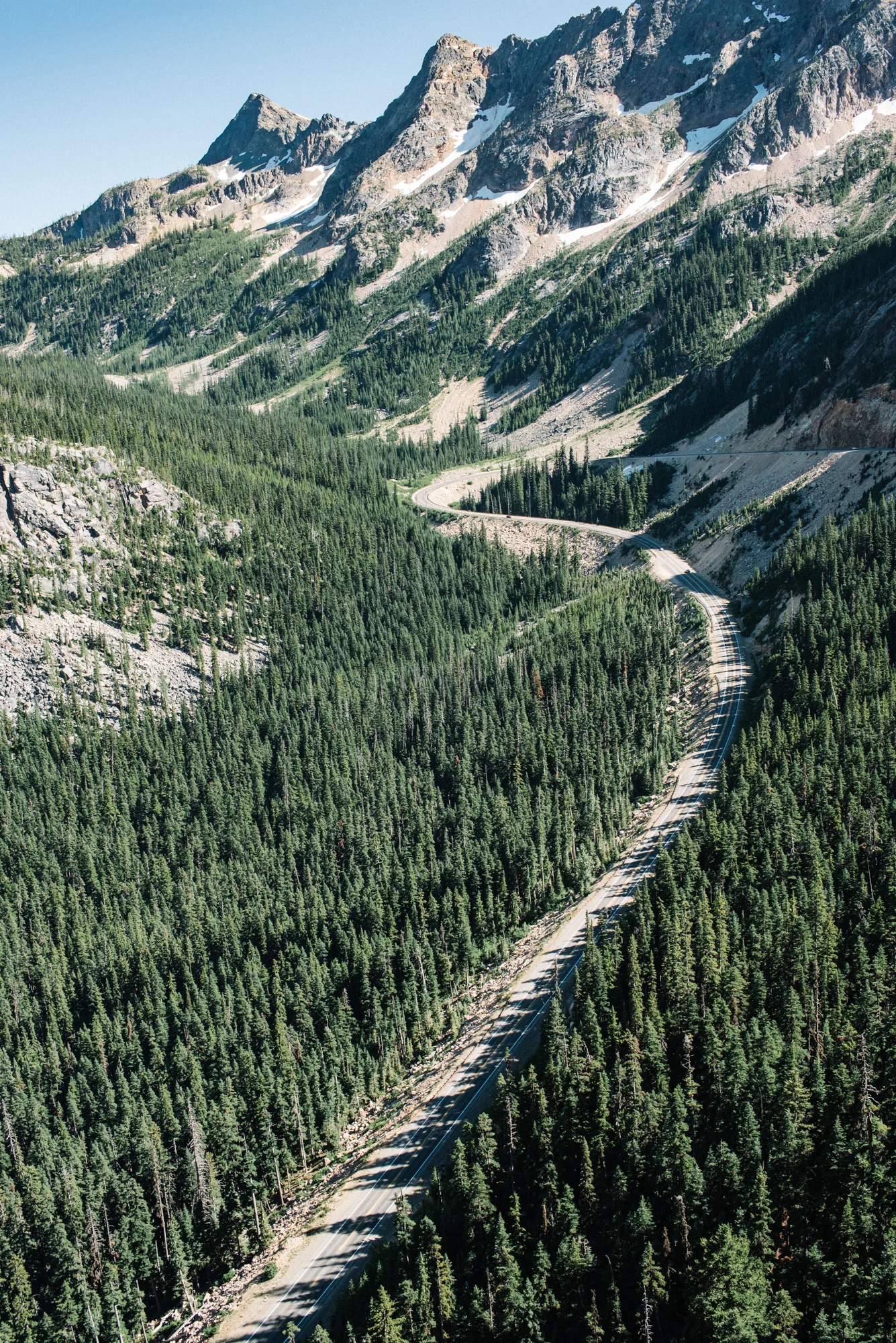


Farther east, we stopped at Washington Pass Overlook. A short paved trail climbed gently around the rocky edge of the viewpoint, opening onto broad views of Liberty Bell Mountain, the Early Winters Spires, and the surrounding valley.
We found a rock bench near the top and sat for a while. Large birds circled over the valley, too distant for us to identify, while moss clung to weathered trees nearby. Far beyond the overlook, a thunderstorm was beginning to build. We watched the dark cell rise against the horizon and looked down at visitors slowly making their way along the path below.
After a day of driving, walking, and stopping at one dramatic view after another, sitting quietly at Washington Pass became my favorite part of the afternoon.
Reaching the Shore of Diablo Lake

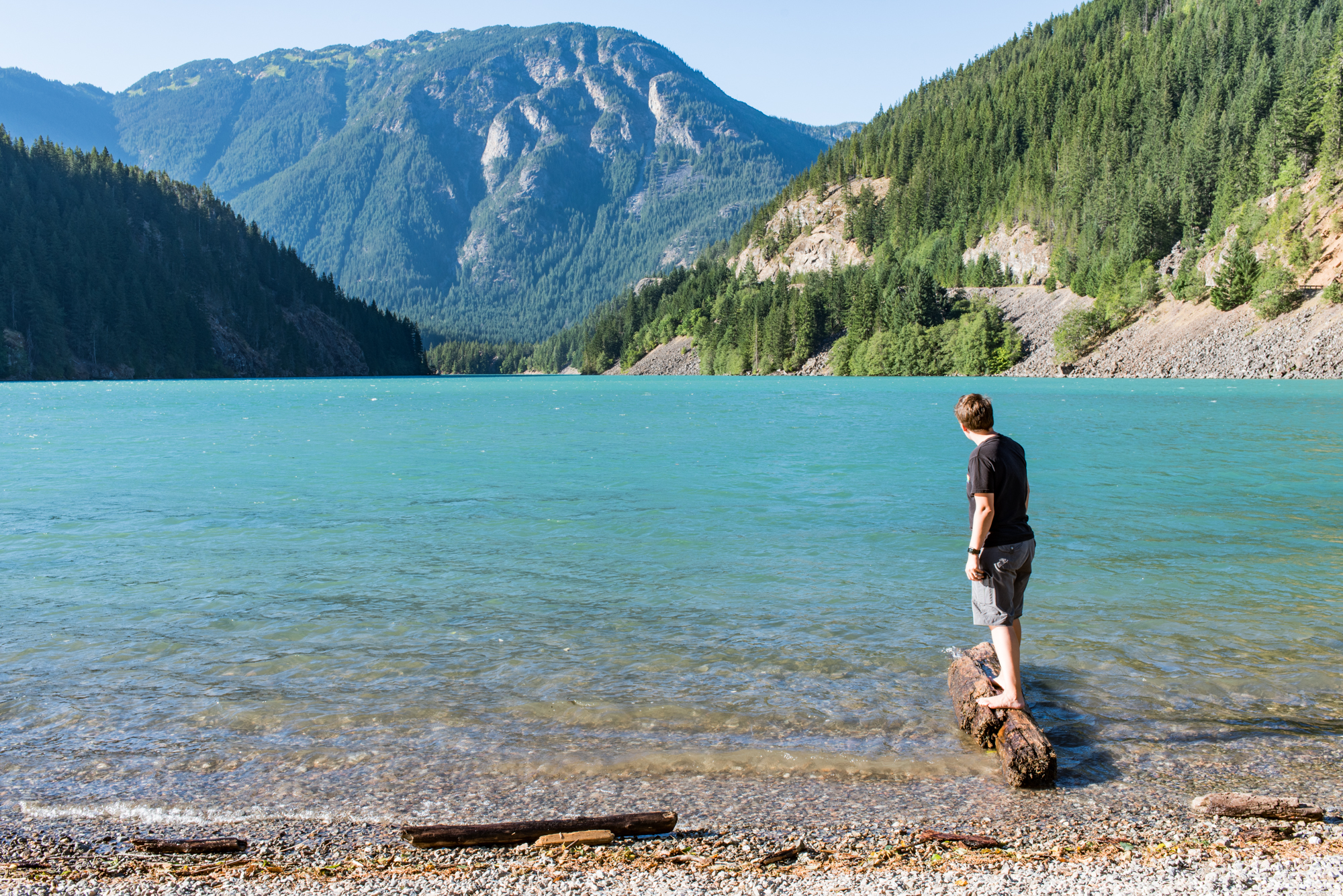


We eventually turned around and headed west toward Diablo Lake. Before leaving, we wanted to find somewhere we could walk down to the water instead of seeing it only from a dam or overlook.
Kim found access near the Thunder Knob trailhead and Colonial Creek Campground, where the boat launch and rocky shoreline brought us right to the edge of the lake. From water level, Diablo Lake felt completely different. The mountains rose sharply around us, and the clear turquoise water stretched away from the rocky beach.
After spending most of the day in hiking boots, we had to dip our feet into the lake. The water was painfully cold at first, then wonderfully refreshing on our hot feet. Within a couple of minutes, our toes were almost completely numb.
Standing at the shoreline gave us one last look at the color we had followed throughout the day, this time close enough to see through the clear water to the stones beneath the surface.
Our day along the North Cascades Highway gave us only an introduction to this enormous landscape. We did not have time for the longer trails that climb deeper into the mountains, but the overlooks, short walks, and cold water of Diablo Lake gave us plenty to remember. We never found Kim’s mountain goats, so we still have a reason to return.