
We rolled into Grand Teton National Park at midnight after a very long day. We had gotten up early to fly into Salt Lake City, squeezed in a couple of hours around town, visited the Cotopaxi store and Epic Brewing, and then picked up our Native Campervan. That was where we met James from Native Campervans and Vanis Joplin, our little home on wheels for the week.
From Salt Lake City, we had a long, winding drive into Wyoming. By the time we reached Gros Ventre Campground, we were tired and nervous about finding an open site. We had experienced one too many late arrivals in Joshua Tree, only to discover that every campsite was full. We got lucky at Gros Ventre. There were a couple of sites available, so we chose one that looked easy to pull into, parked the van, and almost immediately climbed into bed.
Going straight to bed may sound completely normal, but we were used to tent camping. Arriving at a campsite usually meant unloading the car, setting up the tent, inflating sleeping pads and pillows, and building a temporary little home before we could finally crawl beneath the blankets. Doing all of that after dark was rarely fun. This time, I put the van in park, turned around, and climbed into bed. It was one of the best camping experiences we had ever had.
We slept incredibly well. Instead of setting an alarm for sunrise, we let the morning arrive when it was ready. Beginning a weeklong trip with a full night of sleep seemed more important than forcing ourselves out of bed before dawn. We woke a little after eight, rested and excited to see what was waiting outside the cozy van.
Our First Morning at Gros Ventre Campground


Gros Ventre Campground immediately became a place we wanted to visit again. The campground sits in the southern part of Grand Teton, surrounded by open land and broad views beneath the Wyoming sky.
We needed to move fairly quickly after sleeping in because we hoped to find a campsite closer to the center of the park for the next couple of nights. We made breakfast and coffee beside the van, packed up, and headed north toward Colter Bay. The drive was stunning. The sky was blue, the air was clear, and the Teton Range rose sharply above the landscape.
We did not stop for photographs because we wanted to secure a campsite first. We assumed we could return once that practical task was finished. We found a good site at Colter Bay, but smoke from nearby wildfires began moving into the park soon afterward. That first drive became the clearest view we had of the Tetons during the entire visit.
It took some emotional adjustment. We had pictured sharp mountain views, photographs of the range beneath blue skies, and perhaps a quiet lake reflecting the peaks. The smoke softened or completely obscured the mountains and cast strange colors across everything in the distance. The landscape was still beautiful, but it was not the Grand Teton visit we had imagined.
Camping at Colter Bay


Colter Bay Campground was larger and busier than many of the places where we usually camped, but the sites were laid out well. We had a level place to park the van, a small patch of grass with a picnic table and fire ring, and a restroom nearby.
Once darkness settled over the campground, our site became surprisingly quiet. It made a comfortable home for a couple of nights. A rainstorm moved through during our first evening. Having a campervan with an indoor kitchen felt especially luxurious while the rain fell outside.
It was also our fifth wedding anniversary, so we celebrated with a very fancy dinner of Good To-Go Classic Marinara with Penne and a couple of local beers. We ate inside the van while rain tapped against the roof.
Rain and Hail in Grand Teton


Some of the most memorable moments from our time in Grand Teton came from the weather. We stopped for lunch on our first day and soon heard raindrops hitting the van. Rain was not something we experienced very often at home in Southern California, so we climbed outside and stood in it.
For a few minutes, the rain changed to small hail. Little pieces of ice bounced from the ground and rattled against the van while we watched like two people who had never encountered weather before. The showers continued to appear and disappear throughout the day. Rain found us during our walk near String Lake and returned again around dinner.
After watching wildfire smoke erase the distant mountains, the rain felt immediate and alive. We could hear it in the trees, feel the cold drops on our skin, and smell the damp ground beneath the forest.
Walking Along String Lake


Our only real hike in Grand Teton followed the shore of String Lake. We had not planned many long hikes because our visit was short. We expected to spend most of our time chasing mountain views, rivers, and waterfalls. Once the smoke settled in, we improvised and decided to explore the water from a trail instead.
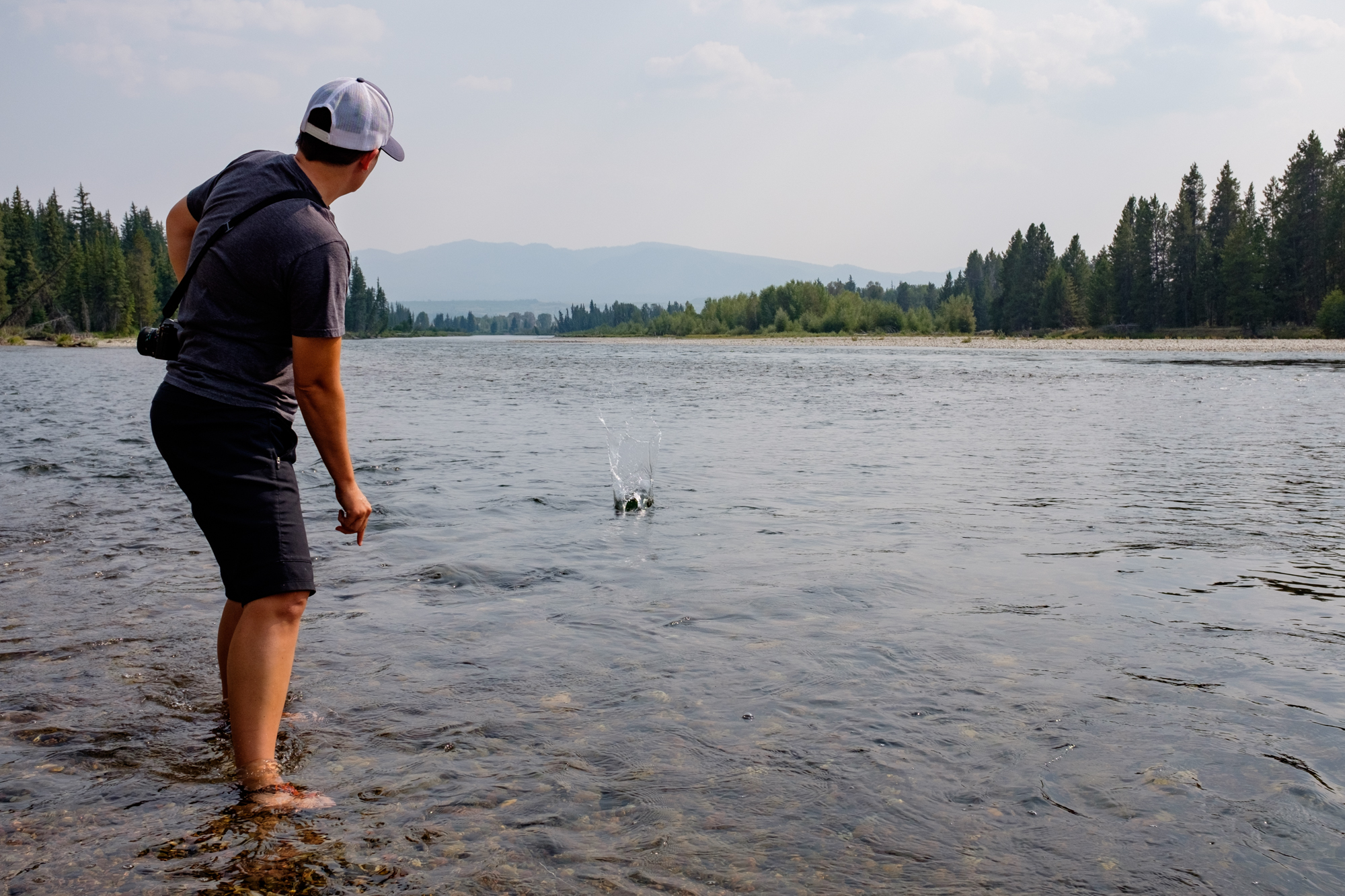
We parked near the String Lake Picnic Area and followed a path into the woods. The trail stayed close to the lake, with the water appearing repeatedly between the trees. After about a mile, Kim could no longer resist it. She stepped into the lake even though the water was cold and only about two feet deep near the shore. I stopped at my knees and stood there while rain fell around us.
The shallow water was clear enough to see the bottom beneath our feet. Forest pressed close to the shoreline, and the rain made the lake feel quieter than it probably would have on a bright summer afternoon. We watched carefully for bears and other wildlife as we walked, but the forest remained quiet. Nothing appeared around the next bend, no matter how hopefully we looked.
Driving to the Top of Signal Mountain


We had not heard about the Signal Mountain Summit Road before receiving our park map. Once we noticed the little road leaving the main route, we had to see where it went. The road was narrow, winding, and paved, with steady climbing through the forest. By then, the smoke had reduced most of the distant views to layers of gray and blue haze.
On a clear day, the overlooks must provide an incredible perspective across Jackson Hole and toward the Teton Range. We could only see fragments of that landscape, but the drive still gave us a quiet place to stop above the busier areas of the park.
The subdued view had its own strange beauty. Mountain shapes faded into one another, and the horizon seemed much closer than it really was.
A Moose at Schwabacher Landing


We woke early on our second morning, hoping to find wildlife and catch whatever clear views might appear before the smoke thickened. Our first stop was Schwabacher Landing. A turnoff led us onto a bumpy dirt road that the van handled without any trouble. We parked, grabbed our cameras and binoculars, and hurried down the trail while still wearing our pajama pants. Almost immediately, we encountered a small group of people watching something in the distance.
A moose was feeding near the water.
We believed it was a cow because it had no antlers, although we could not be certain from where we stood. We watched quietly as it ate its breakfast and slowly moved through the vegetation. Eventually, it stepped into the river and walked across the shallow water. Its size was difficult to understand until we saw it moving through the landscape. The moose looked calm and unhurried, but every long-legged step reminded us how powerful it was.
This was the first large animal we saw in Grand Teton. Ducks and other birds moved around the water, but we did not find any beavers or other mammals. The moose was more than enough.
Early Morning at Oxbow Bend
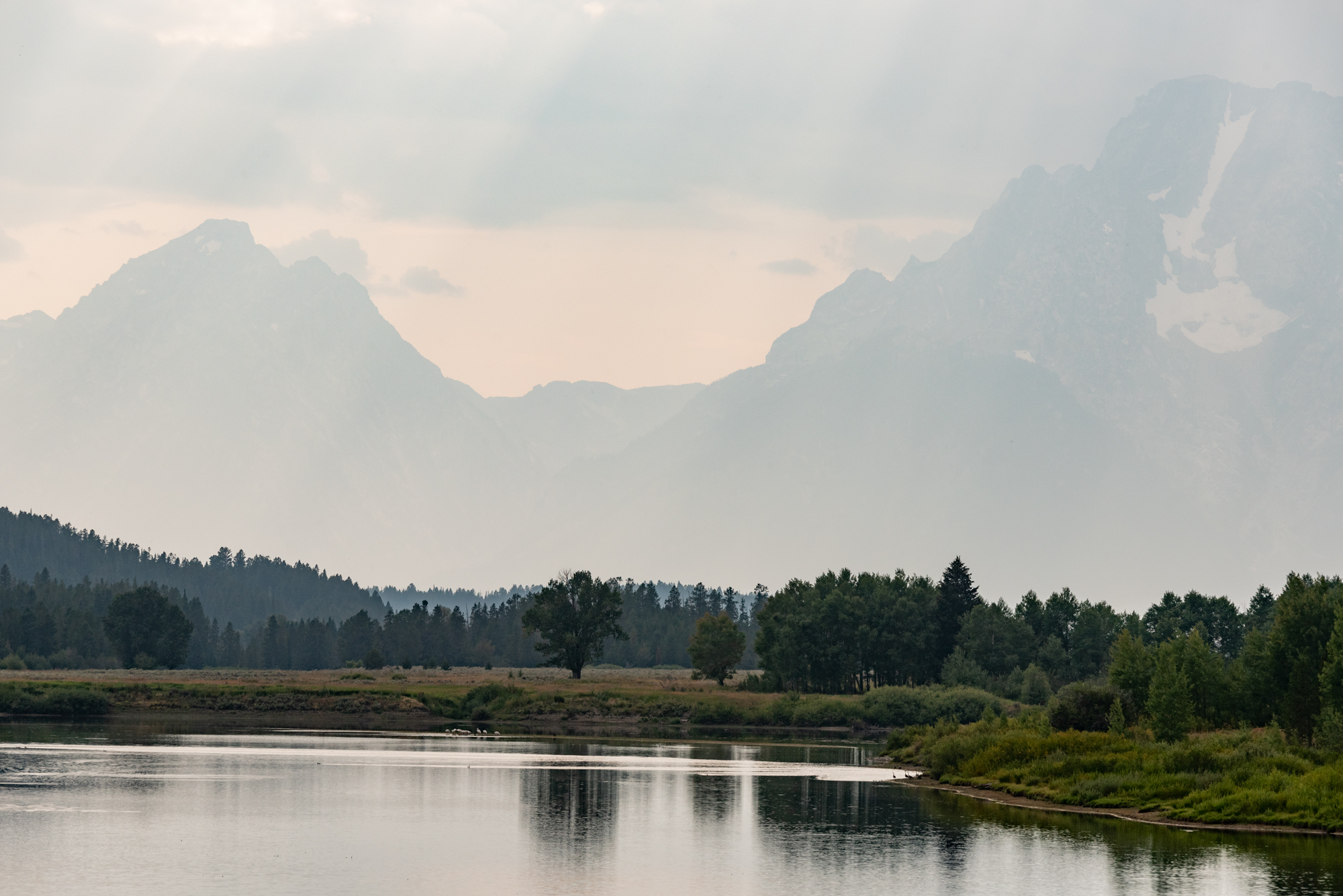


We had heard that Oxbow Bend was one of the best places in the park to watch for wildlife, particularly moose. We visited several times, stopping to scan the shoreline and distant vegetation with our binoculars. We mostly found ducks moving across the water, along with a few elk so far away that we could only study them through our binoculars.
Oxbow Bend did not need a crowd of animals to be beautiful. Early in the morning, a thin layer of mist floated above the water. The smoke muted the distant landscape, while the quiet surface of the river held soft reflections of the trees. We waited for something to emerge from the willows, but the stillness became the scene.
Snake River Overlook and the Ansel Adams View
Many people recognize Ansel Adams’ photograph of the Snake River curving beneath the Teton Range.
It was one of my favorite photographs when I studied fine-art photography in college. At the time, I knew the image but had no real understanding of Grand Teton National Park or where that landscape existed.
Years later, we were finally standing at Snake River Overlook.
The wildfire smoke had taken over by then. At its best, the view was hazy. At its worst, the mountains nearly disappeared.
Even so, I could see the curve of the river, the trees filling the valley, and the Tetons faintly rising beyond them. The view had changed considerably since Adams made his photograph, as the trees had grown and obscured parts of the river, but the shape of the landscape was still recognizable.
Seeing it with my own eyes connected that college photography memory to a real place. I had admired the photograph long before I knew I would ever stand there, camera in hand, making my own smoky version of the scene.
A Campervan Beside the River


With the mountain views hidden by smoke, we decided to slow down and enjoy the campervan. Kim found a winding road that led toward the river and eventually reached a quiet dirt pullout with enough room to park. The water flowed only a few feet away.
We opened the van doors and let the breeze move through. Every so often, kayaks drifted past on the river. Otherwise, we had the place mostly to ourselves. We stretched out on the bed, read for a while, drank a couple of beers, ate lunch, and listened to the water moving past us. This became one of my favorite moments of the entire trip.
We had arrived in Grand Teton expecting to hurry between dramatic mountain views and carefully chosen photography locations. Instead, wildfire smoke led us to a soft dirt road beside the river, where we spent part of the afternoon doing almost nothing. The mountains were still out there, hidden somewhere behind the haze. From the open doors of Vanis Joplin, the river was enough.




Our time in Grand Teton did not look like the visit we had planned. The sky remained smoky, reflections were difficult to find, and the mountain views rarely appeared clearly enough for the photographs I had imagined.
We still stood in the rain and watched hail bounce from the ground. We walked into the cold water at String Lake, watched a moose cross the river at Schwabacher Landing, and saw the Snake River Overlook I had known through an Ansel Adams photograph for years.
Most of all, we discovered how much we loved traveling in a campervan. Arriving after midnight and climbing directly into bed felt luxurious, but the van gave us something even better beside the river. We could open the doors, let the breeze move through our little home, and stay exactly where we were for a while.
We left already thinking about another visit, perhaps outside the height of wildfire season. I still wanted to see those mountains beneath a clear sky, maybe with snow along the peaks and their reflections resting in the water.
Have you been to Grand Teton? Tell us about your experience!